“allow yourself to anticipate that reward, eventually, that craving will make it easier to push through the gym doors every day”
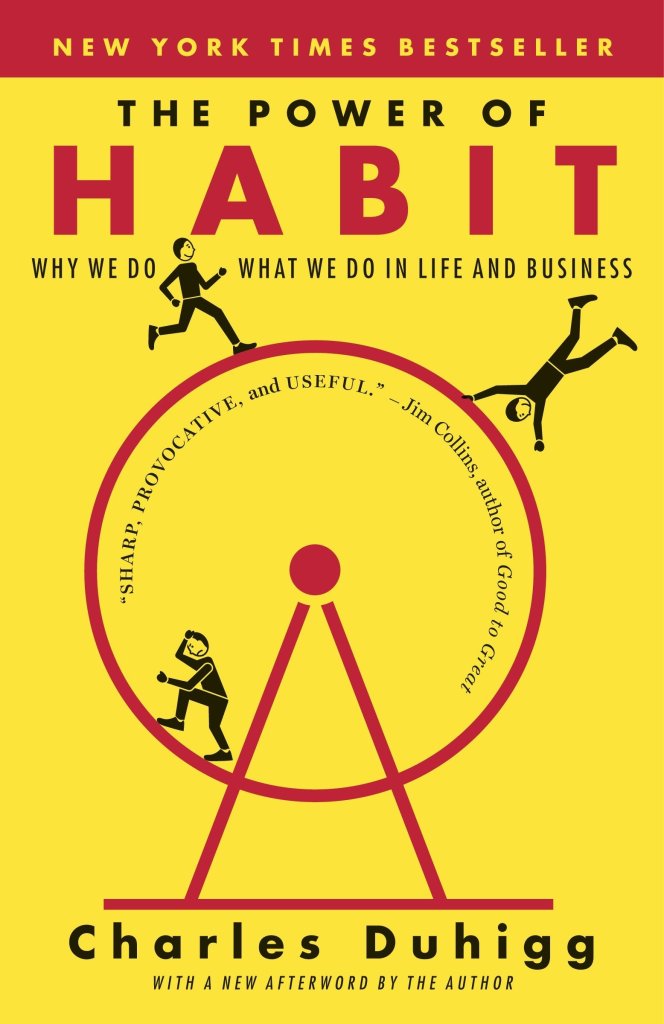
Power of Habit by Charles Duhigg – Paperback Version & Hardcover Version
Writing: ✭✭✭✭✭✭✭ (7/7)
Utility: ✭✭✭✭✭✭✭ (7/7)
🚀 The Book in 3 Sentences
- Most of us believe that our lives are made up of a cumulation of choices. The truth is, though, a large portion of our lives — 40% to be exact — are nearly automatic. Take for instance, when you wake up in the morning: we rub our eyes, check our phone for the time, and quickly slug to the bathroom and begin our morning routines. All of this happens with little to no conscious thought. In fact, during my morning routine, my head is already venturing into what the rest of the day has in store. Why is this? Because our morning rituals are a deeply ingrained habit. And habits — as they are so deeply engrained — require essentially, no effort.
- Put differently, muscle memory to an athlete is habits to people. Learning to curate healthy & sustainable habits are thus the centerpiece of the people who are most successful. People often wonder how it’s possible for people like Bill Gates or Jeff Bezos to consistently push the boundaries of science and innovation. “Don’t they ever get tired?” they ask. And while they do get tired, their foundation — habits that catalyze critical thinking, happiness, & ambition — ensure that they steadily move forward, even when they face setbacks. Whether you like it not, the biggest difference between most people and Jeff Bezos isn’t IQ — it’s their daily habits.
🎨 Who Should Read It?
- Literally EVERYONE. 7/7 in utility & readability. I mean, literally, everyone has habits.
- When I picked up “Power of Habit,” I second-guessed if it was a book worth devoting a week to reading. I felt as if I knew the basics about habits already: they comprise 40% of our lives, they help build momentum (good & bad), and give us basic drive & direction. After reading it, however, I can confidently say, it was well worth the time. Duhigg does an amazing job blending concepts, images, and examples to accurately convey points regarding habits. As an added bonus, Duhigg uses examples & studies that are so fascinating that they end up becoming great talking point with friends.
☘️ How the Book Changed Me
- Made me self-aware of the three parts to a habit — cue, routine, and reward. These are pretty self-explanatory, but every habit comes in three parts. The cue — a location, feeling, time, or desire — compels your brain to enter the second phase, the routine. The routine is the act that you do after the cue, and it leads to the result, which is often a feeling or emotion. Once you understand that these three components make up a habit, the potential becomes limitless. For me, whenever I try to create a new habit, I choose to build in specific triggers & cues. This way, I can essentially trick my brain into going into automatic mode, especially over time.
- For example, whenever I go to the gym, I deliberately put on a baseball cap. I also deliberately put my water bottle & backpack in the same position on the shotgun every time. I also put my phone and wallet in the same part of the car every time. And while, at first, I had to consciously put things in that order, it feels so automatic now. Oftentimes, I don’t even think about it anymore. I just do it. I’m only remembering because I’m specifically trying to recall how I do it. Through this, my habit of going to the gym has become easier to hold — the more time we spend in “habit” mode, the less conscious effort my brain has to make.
- Besides those three parts, however, it also taught me about the fourth part of a habit: craving. It is when, before you even do the activity, you experience the sensation of doing it. It’s almost like spending money you haven’t earned yet, but you think you’ll get by next week. Once you experience the pleasure in your head, your body begins to crave that activity. A good example — when your phone buzzes, we often begin to experience the “pleasure” already. We ponder the different possibilities: “maybe my GF is texting me, or maybe I just got a comment on my newest post.” Whatever it is, we often feel this intense pull or desire to check our phone after hearing the notification, even though we don’t know what the exact notification is for. This is craving. Learning to create cravings for something makes the habit that much easier to maintain. For me, before I work out, I imagine the sense of accomplishment and contentedness I will feel after. I’ve done that enough that I now crave going to the gym — without it, I feel off.
- Taught me that certain habits are more important than others — “keystone habits.” All habits are NOT created equal. Studies have shown that specific types of habits can help transform your entire lifestyle. It explains why some people who are unemployed, fat, sad (ext… all the qualities society deems as bad) can, within a single year, turn into a successful, happy, and healthy CEO of a thriving company. How is it possible to transform your life so much in such a short duration? Keystone habits — central habits that give you little wins that allow you to accrue momentum throughout the rest of the activities you do, allowing you to snowball your one great habit, into many many habits. One of the most well-known keystone habits is “exercising.” This is because, once you exercise, and you feel great, it makes your brain feel as if it’s starting the day with a hard start. So what if they schedule you for an extra call for work and you get set back a little? You’re still starting with a head-start. That head-start mentality creates a snowballing effect of productivity and high achievement. You let the momentum carry you into starting even better habits & you refuse to let setbacks ruin your day. This is why, when you move to somewhere new, you should always focus on developing a few keystone habits, rather than trying to make sure you do everything correct. With the right keystone habits, everything else will likely fall into place with time.
- Showed me how to identify and correct unhealthy and unsustainable habits. As we mentioned before, there are three parts to a habit. Two of those three parts are incredibly hard to change — the trigger (especially if it is emotional) can be impossible to avoid. Alcoholics, for example, often drink to escape their emotional troubles. Those emotional troubles are thus their triggers and are nearly impossible to avoid. The reward of escaping (while short term), also stays constant. Because of this, the best way to change a bad habit — say, eating comfort food when you’re sad — is to create a new routine to satisfy that same reward. Let’s say, for instance, when you feel sad and empty, your first instinct is to open up the pantry. To fix that habit, when that instinct kicks in, you force yourself to do something else. Play a game of League of Legends. That helps satisfy the “escaping of reality.” This way, you can stop yourself from turning to the routine of eating to escape. You can do other things that accomplish the same thing but don’t jeopardize your health.
- Made me better at making decisions and understanding long-term consequences of habit. I understand that nearly everything I do carries future momentum. No more “I’m only going to splurge tonight.” Because splurging just that one night will mean that it becomes familiar to my brain. It becomes more “automatic” and requires less conscious thinking and willpower. It becomes closer to a habit. Obviously, this also applies in the reverse. Working hard, even for one night, will make working hard in the future a bit easier and a bit more familiar.
✍️ My Top 3 Quotes
- “exercise spills over. there’s something about it that makes other good habits easier.”
- “every company adds sodium laureth sulfate to make toothpaste foam more. there’s no cleaning benefit, but people feel better when there’s a bunch of suds around their mouth. once the customer starts expecting that foam, the habit starts growing.”
- “allow yourself to anticipate that reward, eventually, that craving will make it easier to push through the gym doors every day.”
 KZ Blogs