“the frog and the rat are always watching out for us.”
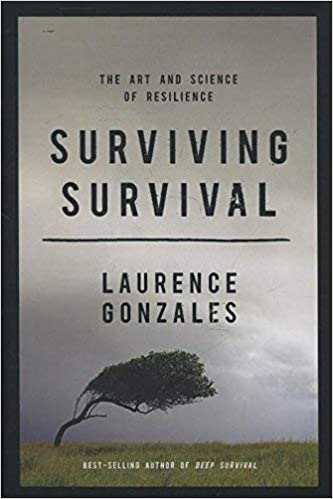
Surviving Survival by Laurence Gonzales – Hardcover Version
Writing: ✭✭✭✭✭✭✭ (7/7)
Utility: ✭✭✭✭✭✭✭ (7/7)
🚀 The Book in 3 Sentences
- We often think the story ends once the main character survives the longest 48 hours of their life. Unfortunately, that’s not how things work, even though we often wish it could. In Laurence Gonzales’s first book, “Deep Survival,” said expectation is quite correct. In “Surviving Survival,” the sequel, however, a light is shown on what is often the hardest part of surviving: survival after surviving. Gonzales takes us on a magnificent journey through the lens of different survivors. He captures complicated neuropsychology into bit-sized chunks, whilst demonstrating the willpower it takes to fight the maladaptive memories and associations our dinosaur brain creates during traumatic accidents.
- While we remember little from traumatic incidents, our brain remembers all. It is magnificent, even when it works against us. When we awake after losing a leg, we remember the core sequence of events: walking into the water, being greeted by an intense jolt, and the water turning a crimson cloud of red. In another case, after a bad breakup, we may find ourselves unexpectedly crying at the sight of a striped colored blouse. Why? Because it brings us back to the person we used to be; it serves as a painful reminder of the person we used to love. You would have never guessed that a blouse would be the trigger.
🎨 Impressions
- 7/7 Utility.
- 15/7 in Writing. I don’t think I ever felt like there was a dull moment. If you ever want a heart-racing, edge-of-your-seat read, this is it.
Who Should Read It?
- People who want to better understand how our bodies respond to the unthinkable. The journey of surviving is so so hard. Reading this book not only makes you more self-aware of the causes for your reactions but also informs you of new methods to deal with said reactions. It is truly one of the most well-written books on how our brains respond to trauma.
☘️ How the Book Changed Me
- It gave me perspective on the unexplainable anxiety that I sometimes experience. There are often times when I’m suddenly taken by a wave of anxiety. I can’t explain it. There is nothing that explicitly reminds me of my previous trauma. My brain tries to rationalize the feeling, as it always does, but nothing comes to mind. What is this feeling, I wonder. At some point, more of the anxiety comes from the fact that I am unaware of its cause than the original anxiety itself. A vicious cycle, indeed. Laurence, however, does not fail to deliver. In some of the most simple English, he describes how there are three parts to our brain. Layer one is reptilian; layer two is mammalian; layer three is uniquely human (the neocortex). But we haven’t lost the other layers through evolution – we can use them, but can’t always explain what they are. “The frog and rat are always watching out for us,” explaining why we may sometimes proclaim that we have a terrible “gut feeling.” It is because the animal brain, drawing on its millions of instinctive & subconscious connections, is alerting us of a danger that we may not have a rational explanation for yet. To the brain, correlation IS causation. In life or death situations, there is no time to think. There is only time to react.
- A caveat of this, however, is that moving can be one of the most therapeutic activities. For those who are traumatized, it is the best environment we can be in — one where we have no previously-stored mental models or subconscious connections; one where we have a clean slate. We can walk around without fear of an unexpected trigger. It might explain why going to California for college helped me heal so much faster.
- Informed me of how to approach trauma and healing. It teaches that one of the most effective methods is “over blanketing” solutions that can bring you back to earth. Your brain cannot be both “calm” and “overwhelmingly anxious” at the same time. It is psychologically, neurologically, and physically impossible. Because of that, finding activities that ground you in a state of “calm” can help silence the negative feelings that your frog brain sends coursing throughout your skin. It’s why people have coping mechanisms that they do whenever they recognize that eerie feeling creeping into their hearts. For me, I run to the basement and begin punching my punching bag. It lets me release all of my pent-up energy whilst calming myself.
- It also taught me that it’s oftentimes impossible to heal completely. You can rarely untraumatize yourself — in the earliest ages of our civilization, split-second connections to danger (even if irrational) helped us escape death. Thousands of years later, our system is still built through that same foundation. In that regard, you must learn to forgive yourself when you wake up and feel utterly paralyzed — defenseless to the demons of the world. Those split-second connections were beneficial to our ancestors, and while not to us, it’s good to know that they are impossibly hard to undue. With time and practice, however, it is possible to soften the reaction. Still, it taught me that sometimes I just need to forgive myself for how I feel. I can’t just wake up and be better, even if I want to be.
- It clued me into how ephemeral pain, suffering, and happiness are. While this sounds quite nihilistic, it is more of an optimistic thing to note. For the most part, it means, no matter how much pain we suffer at any one moment, and how existential it may seem at that given time, we can move beyond. It does not, however, argue that happiness cannot continue, as long as you actively continue to create it. The bottom line is as follows: with enough focus on coping, anyone can still experience profound happiness; they can still lead a life worth living. Gonzales illustrates this point with one of the most heart-wrenching, graphically disturbing, and horrifying stories from the view of a holocaust survivor. It talks about how someone who had to bury his family, thousands of jews, and live in a constant state of anorexia was able to lead a fulfilling life, despite living in that constant state of distress for more than a decade.
✍️ My Top 3 Quotes
- “the frog and the rat are always watching out for us.”
- “we begin to see the entire world through the lens of trauma.”
- “when you’re in the midst of a crisis, it can sometimes seem as if your distress will go on forever… for most people in most situations, the pain does not go on forever”
- “In the brain, the cardinal rule is: future equals past; what has happened before will happen again. In response to trauma, the brain encodes protective memories that force you to behave in the future the way you behaved in the past. The trouble was that in all likelihood, Debbie would never again face a similar hazard.”
 KZ Blogs